

A missed customer call rarely feels like an infrastructure problem until it starts happening every week. Then it becomes an operations problem, a service problem, and eventually a revenue problem.
A business IP phone system helps solve that by moving voice communications onto a managed data network, where call quality, scalability, and visibility are easier to control.
For many organizations, the real question is not whether IP telephony is better than legacy phone service. It is whether the phone system will fit the way the business actually operates. A front desk handling high call volume has different needs from a warehouse office, a school campus, or a multi-site retail group. The right system should support those differences without creating extra complexity for IT or facilities teams.
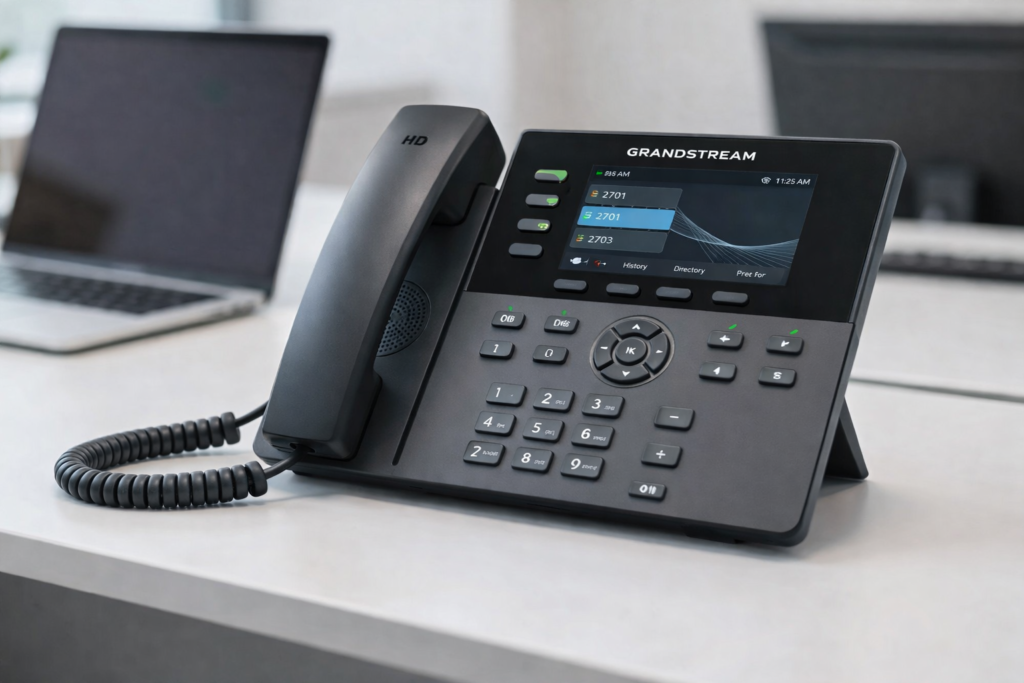
What a business IP phone system actually changes
A business IP phone system uses your network and internet connection to carry voice traffic rather than relying only on traditional analog lines. That sounds like a technical shift, but the business impact is more practical. You gain flexibility in how extensions are deployed, how calls are routed, how sites are connected, and how users are managed.
In a conventional setup, adding new lines or moving handsets can involve more disruption than most businesses want to deal with IP telephony.
A user can often move desks, change departments, or join a new site with less rework, provided the underlying cabling and network are designed properly. That matters during office reconfiguration, expansion, or relocation, when communications downtime can quickly affect staff productivity.
There is also a visibility advantage. IT teams can manage users, hunt groups, call forwarding rules, voicemail, and device status from a central interface instead of chasing issues across disconnected hardware. For growing companies, that central control is often one of the biggest reasons to modernize.
Why older phone setups start holding businesses back
Legacy phone systems often stay in place long after they stop being efficient. They may still make and receive calls, but that is a low bar for a business environment that now expects mobility, remote access, integrated call routing, and easier scaling.
One common issue is inflexibility. If your organization is adding departments, opening new locations, or supporting hybrid staff, a traditional system can become costly to extend. Another issue is supportability. Older PBX hardware can be difficult to maintain, replacement parts may be limited, and fewer providers want to work on aging platforms.
There is also the problem of fragmentation. Many businesses have one vendor for cabling, another for networking, and another for phones. When call quality drops, no one takes ownership because each provider points to a different cause. In reality, voice performance depends on the whole environment – switching, structured cabling, router configuration, bandwidth, handset quality, and power backup all play a role.
The infrastructure behind reliable voice performance
A business IP phone system is only as dependable as the network carrying it. That is where many buying decisions go wrong. Businesses focus on handset features and monthly pricing but overlook the infrastructure that determines whether users hear clear audio, experience dropped calls, or lose service during a power event.
Structured cabling is the first layer. Poor terminations, inconsistent cable runs, and undocumented patching can create intermittent voice issues that are hard to trace. If the office is already dealing with weak connectivity or patchwork network upgrades, introducing IP telephony without correcting those conditions can produce disappointing results.
Switching and network design matter just as much. Voice traffic needs predictable performance, especially in offices with heavy data usage, cloud applications, video meetings, or guest Wi-Fi. Quality of service settings, VLAN segmentation, and proper switch capacity help prioritize voice packets so conversations remain clear even when the network is busy.
Power is another factor that decision-makers sometimes overlook. Many IP phones rely on Power over Ethernet. That simplifies deployment, but it also means your switching environment and backup power strategy need to be planned carefully. If business continuity matters, the phone system should be considered alongside UPS protection, internet redundancy, and failover options.
How to evaluate the right system for your business
The best approach starts with operations, not features. Before comparing models or platforms, define how calls move through the business. Consider who answers incoming calls, whether teams need direct inward dialing, how after-hours routing should work, and whether multiple locations need to appear as one organization to customers.
User count matters, but growth plans matter more. A 25-person office today may become a 60-person operation within two years. Choosing a system that fits only current headcount can create another migration sooner than expected. On the other hand, overengineering for a scale you may never reach can waste budget. This is one of those areas where it depends on hiring plans, office strategy, and how stable your operating model is.
Device needs should also be realistic. Some users need physical desk phones with BLF keys, transfer controls, and reliable call handling throughout the day. Others may work better with softphones or mobile apps. A reception area, executive office, call-heavy department, and warehouse supervisor do not all need the same endpoint.
Security should be part of the conversation from the start. Voice systems are network-connected systems, which means they should be deployed with the same discipline applied to the rest of business infrastructure. Access controls, firmware management, firewall policy, and segmentation all matter. For organizations handling sensitive customer or internal information, this is not optional.
Business IP phone system options for different environments
There is no single best business IP phone system for every organization because the operating environment changes the requirements.
For a small office, the priority may be straightforward call handling, simple administration, and room to grow without a full-time telecom specialist. In that case, ease of use and cost control may outweigh highly specialized features.
For a multi-site business, interoffice dialing, centralized management, and consistent call flows become more important. If locations are opening or changing regularly, the system needs to support repeatable deployment and easy onboarding.
For schools, healthcare offices, or facilities with public-facing operations, resilience and clear internal communication can be just as important as customer calling features. Paging, departmental routing, and dependable handset availability may take priority.
For businesses undergoing relocation or renovation, timing is critical. The phone system should be planned with the cabling, switching, Wi-Fi, and physical workspace layout rather than treated as a late-stage add-on. That coordinated approach usually reduces rework and helps avoid handoff problems between vendors.
Common mistakes that create avoidable problems
The most common mistake is treating IP telephony like a standalone product purchase. It is not. It is part of the wider business infrastructure. When phones are installed on top of poor cabling, undersized switches, or unmanaged network congestion, issues follow.
Another mistake is choosing based only on upfront cost. Lower-cost equipment may be perfectly suitable in some environments, but only if it is supported by the right design. Choosing the right business IP phone system involves careful planning of your network infrastructure. A cheaper handset does not save money if it contributes to support calls, frustrated users, or an early replacement cycle.
Some organizations also underestimate change management. Even a strong system can create friction if users are not shown how to transfer calls, access voicemail, use presence features, or route calls correctly. Adoption affects value just as much as technology does.
Finally, many businesses fail to think about integration. If your organization is already improving cabling, upgrading switching, adding access control, or redesigning office connectivity, phone deployment should be considered in the same project scope. A coordinated rollout is usually more efficient than solving each system in isolation.
Why implementation matters as much as the platform
Two businesses can buy similar equipment and get very different outcomes. The difference usually comes down to assessment, design, and deployment quality. A good implementation partner looks beyond the handset count and asks how the environment is wired, how traffic is managed, what resilience is required, and how the phone system fits into broader workplace operations.
That matters especially for organizations that do not want to coordinate multiple contractors across cabling, networking, and communications. An integrated approach reduces finger-pointing and gives the business a clearer path from planning to live service. For companies balancing uptime, security, and growth, that is often more valuable than any single feature on a product sheet.
At I-Weblogic Pte Ltd, this is the practical advantage of combining IP telephony with network infrastructure expertise. The phone system performs better when it is deployed as part of a secure, scalable environment rather than as a disconnected layer.
A phone system should make daily operations easier, not create another source of uncertainty. If your business is growing, relocating, or modernizing its infrastructure, this is a good time to look at how voice fits into the bigger picture and choose a system that will still work when the business changes.


Pingback: Fiber Optic Network Installation for Business - I-Weblogic Pte Ltd