
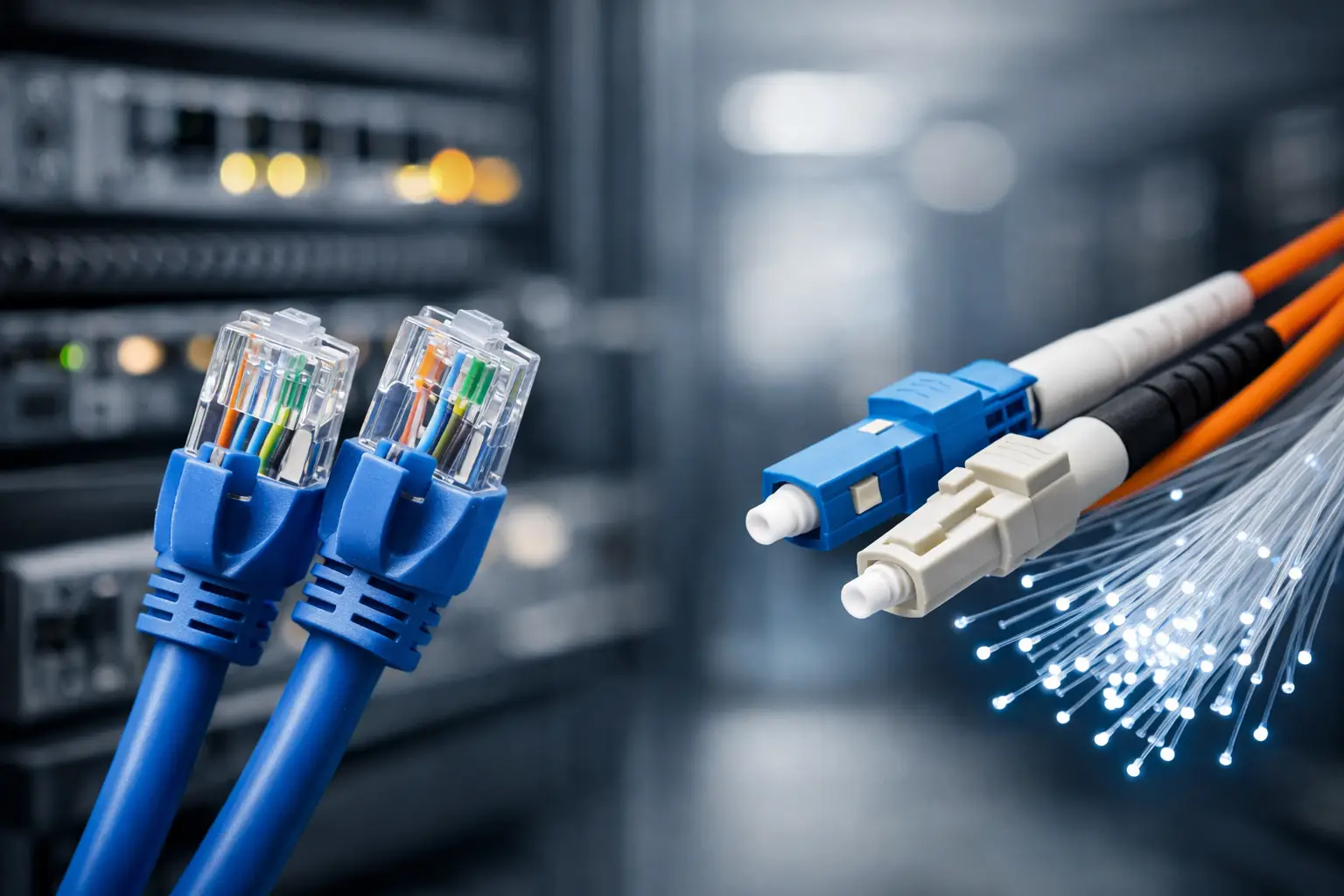
A slow office network rarely fails all at once. More often, it shows up as dropped calls in one meeting room, lag during file transfers, or new devices pushing an older cabling setup past its limit. When businesses compare cat6 vs fiber optic, the real question is not which cable is better in theory. It is which one fits the way your site operates today and how much room you need for growth.
For most organizations, this decision affects more than internet speed. It influences switch design, equipment placement, future expansion, installation complexity, and long-term upgrade cost. If you are planning a new office, upgrading an aging network, or connecting multiple floors or buildings, the right cabling choice can prevent years of avoidable disruption.
Cat6 vs fiber optic: what changes in practice?
Cat6 is copper-based Ethernet cabling widely used for structured cabling in offices, retail spaces, schools, and commercial buildings. It is a practical standard for connecting workstations, phones, wireless access points, printers, and many everyday networked devices. For many business environments, it delivers the performance needed for routine operations without overengineering the network.
Fiber optic uses light rather than electrical signals to transmit data. That difference matters because it allows much higher bandwidth over much longer distances, with stronger resistance to electromagnetic interference. In plain terms, fiber is often the better fit for backbone links, inter-floor connections, campus environments, data-intensive operations, and organizations that expect network demand to increase.
The gap between them is not simply speed. It is also about distance, resilience, scalability, and where each cable belongs in a business infrastructure plan.
Where Cat6 makes business sense
Cat6 remains a strong option for horizontal cabling, meaning the cable runs from the telecom room to desks, devices, and access points. In a typical office, most runs stay within the standard distance limits, and the bandwidth demand at the endpoint does not always justify fiber all the way to every user location.
That is why Cat6 is still common in office fit-outs and commercial upgrades. It supports many core business functions well, including VoIP, general data traffic, Wi-Fi backhaul, and day-to-day user connectivity. It is also familiar to most installers and IT teams, which can help keep deployments straightforward.
Cost is another reason businesses continue to choose it. Cat6 cable, termination, and related hardware are typically less expensive than fiber components. If you are wiring a standard office floor with predictable device density and modest run lengths, Cat6 often provides solid value without unnecessary spend.
There are trade-offs. Copper has shorter distance limits, is more vulnerable to interference in certain environments, and offers less headroom for future bandwidth growth than fiber. For businesses installing new infrastructure with a five- to ten-year horizon, that matters.
Where fiber optic is the stronger investment
Fiber optic becomes more attractive when the network has to do more than support desk connections. If you are linking server rooms, connecting multiple floors, supporting high-capacity wireless deployments, or planning for heavy data movement, fiber provides a stronger foundation.
Distance is one of the clearest advantages. A fiber backbone can cover runs that would be impractical or impossible for copper without introducing additional intermediate equipment. That makes it especially useful in larger offices, warehouses, schools, medical facilities, and multi-building sites.
Fiber also performs well in environments where electrical interference can affect copper cabling. Industrial equipment, dense building systems, and certain power conditions can make copper less predictable. Fiber avoids many of those issues and supports cleaner transmission over long runs.
From a planning perspective, fiber is often the better choice when growth is expected. If your business is expanding headcount, adding cloud-connected applications, increasing surveillance traffic, rolling out more access points, or preparing for higher-capacity switching, fiber gives you more room to scale without revisiting the cabling layer too soon.
Speed is only part of the cat6 vs fiber optic decision
It is easy to reduce this conversation to a speed comparison, but that can lead to the wrong decision. Yes, fiber supports higher speeds and greater bandwidth potential. But the best answer depends on how traffic moves through your environment.
For example, a small office with stable staff numbers and standard business applications may see little operational benefit from running fiber to every desk. On the other hand, a company with centralized storage, frequent large file transfers, video-heavy collaboration, security systems, and dense Wi-Fi usage may quickly outgrow a copper-only design.
This is why network architecture matters more than product labels. In many business settings, the most practical design is not Cat6 or fiber across the entire site. It is a hybrid approach that places each medium where it delivers the most value.
Why many business networks use both
A well-designed commercial network often uses fiber for the backbone and Cat6 for endpoint connections. That approach balances performance, budget, and flexibility.
Fiber can connect main distribution rooms, IDFs, server spaces, and separate building areas with high-capacity links. Cat6 can then handle the final connection to desks, phones, cameras, and wireless access points. This avoids overspending on fiber where it is not needed while still protecting the network from the limitations of an all-copper backbone.
For many organizations, this mixed design is the most sensible answer to the cat6 vs fiber optic question. It aligns infrastructure spend with actual business use rather than chasing a one-size-fits-all specification.
Installation, maintenance, and upgrade considerations
Initial material cost matters, but it should not be the only budgeting factor. Businesses also need to consider installation conditions, downtime risk, future labor, and how easily the network can adapt to change.
Cat6 is generally simpler and cheaper to terminate, and many teams are comfortable working with it. That can reduce upfront project complexity in standard office environments. However, if a business installs Cat6 in places where fiber is likely to be needed later, the short-term savings may lead to more disruption and rework down the line.
Fiber installation can require more specialized handling, testing, and termination expertise. But when designed properly, it can reduce future upgrade friction. If you know a site will need high-capacity backbone connectivity, installing fiber from the start is often more cost-effective than retrofitting after growth creates pressure.
Physical layout also matters. If telecom rooms are poorly positioned, if distances are long, or if multiple risers and floors are involved, fiber may simplify the design. If the environment is compact and straightforward, Cat6 may be entirely appropriate for much of the network.
How to choose for your site
The right decision starts with operational questions, not cabling preferences. How far do your cable runs need to go? Are you supporting one floor or multiple buildings? What applications are driving traffic? Are you adding more cameras, access points, IP phones, or connected systems? How long do you expect this infrastructure to serve before a major refresh?
If your project is an office relocation or expansion, this is also the time to think beyond data drops. Cabling decisions affect wireless coverage, IP telephony, access control, CCTV, and network security design. A fragmented approach can leave you with mismatched infrastructure and limited room to grow.
That is why many businesses benefit from working with an implementation partner that looks at the full environment rather than just the cable type. A practical design review can identify where copper is enough, where fiber is necessary, and how to avoid overbuilding or underbuilding the network. For organizations balancing uptime, security, and expansion, that planning stage often matters more than the hardware itself.
I-Weblogic typically sees this in projects where structured cabling, wireless networking, and physical security need to work together as one system rather than as separate installations.
The better question is what your network needs next
Cat6 is cost-effective, proven, and still well suited to many endpoint connections. Fiber optic offers higher capacity, longer reach, and better long-term scalability. Neither is automatically the right answer across an entire business environment.
A good network design matches the cable to the purpose. If you are wiring a standard office floor, Cat6 may be the practical choice. If you are building a backbone for growth, connecting longer distances, or planning for higher-capacity infrastructure, fiber is often the smarter investment.
The most reliable result comes from treating cabling as part of a larger business system. When the network is designed around your operations, expansion plans, and risk tolerance, the infrastructure works harder for the business long after installation is complete.


Pingback: Office Expansion Cabling Strategy That Scales - I-Weblogic Pte Ltd
Pingback: Telecommunication Infrastructure Planning Guide - I-Weblogic Pte Ltd
Pingback: Ethernet Switch Versus Router: Business Network Basics - I-Weblogic Pte Ltd
Pingback: Fiber Installation That Supports Business Growth - I-Weblogic Pte Ltd