
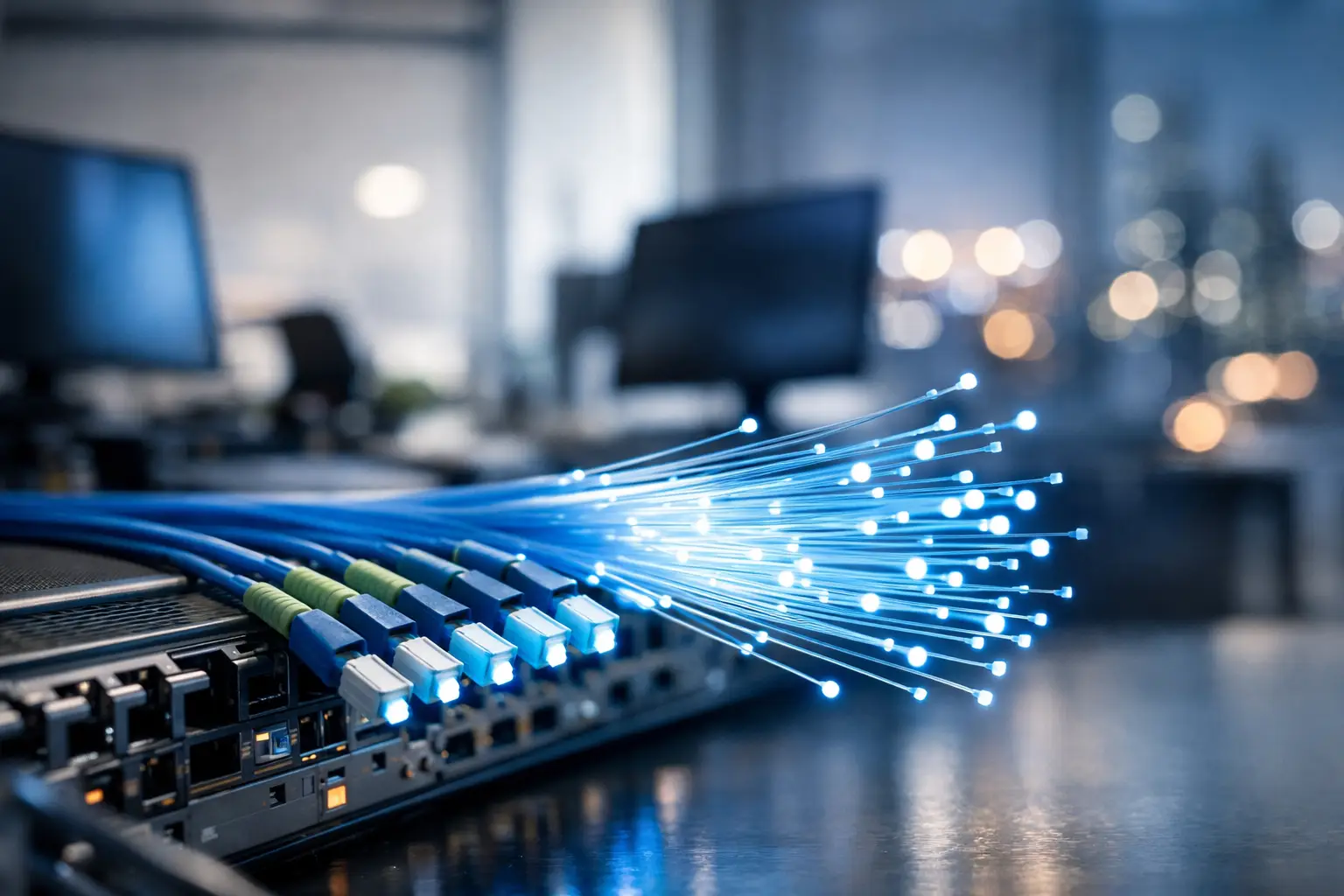
Deciding fiber optic cabling for business is a strategic choice, but it is not automatically the right fit for every part of your network. When a business starts seeing dropped calls, slow file transfers, lag in cloud applications, or patchy performance between floors, the problem is often deeper than internet speed. In many cases, the real issue is the physical network foundation. That is why fiber optic cabling for business has become a serious consideration for companies that need dependable connectivity, not just higher headline speeds.
For operations leaders and IT managers, this is not a trend purchase. It is an infrastructure decision that affects uptime, expansion plans, security systems, and day-to-day productivity. The right cabling design can support growth for years. The wrong one can create recurring bottlenecks that are expensive to work around later.
The Real Advantages of Fiber Optic Cabling for Business
Copper cabling still has a place in many environments, especially at the endpoint. It is widely used, cost-effective, and suitable for many workstation connections. But business networks have changed. Offices rely more heavily on cloud platforms, VoIP, video meetings, smart access control, IP cameras, centralized storage, and bandwidth-hungry wireless access points. As those demands increase, the limitations of older cabling become more visible.
Fiber transmits data using light rather than electrical signals. In practical terms, that allows much higher bandwidth over longer distances with less signal degradation. For a business, that usually translates into stronger backbone performance between server rooms, telecom closets, floors, buildings, or key network aggregation points.
This matters most in environments where stability is tied directly to business output. A corporate office with heavy video conferencing, an education campus with multiple buildings, or a retail chain moving data and security traffic across sites will feel the difference faster than a small office with basic internet use.
Where fiber makes the biggest business impact
The strongest case for fiber is usually not every desk connection. It is the backbone of the network.
A common example is an office with multiple floors. If each floor has switches, wireless access points, IP phones, and surveillance devices feeding back to a central network room, copper uplinks can become a choke point. Fiber is often the better choice for those uplinks because it handles greater capacity and distance with more room for future demand.
The same applies to campus environments, warehouses, manufacturing sites, and buildings with separate blocks or annexes. Distance matters. Copper is more constrained, while fiber is designed for longer runs without the same performance drop. If a business is planning an expansion, renovation, or relocation, this is often the right time to build that capacity into the infrastructure rather than retrofit it later.
Fiber also fits well in businesses consolidating multiple systems. Security cameras, door access, Wi-Fi, telephony, and core data traffic are no longer separate conversations. They share infrastructure and affect one another. A stronger cabling backbone helps reduce the friction that comes from trying to run modern systems on yesterday’s design.
The real advantages of fiber optic cabling for business
Speed gets the attention, but it is not the only reason businesses invest in fiber.
Capacity is a major factor. As more users, devices, and cloud services rely on the same network, the backbone needs to carry that traffic without congestion. Fiber gives more headroom, which is valuable even if the business does not need peak performance today. It helps avoid the pattern of constant upgrades every time operations grow.
Reliability is another reason. Stable internal connectivity affects more than IT. It supports VoIP quality, access control responsiveness, camera feeds, file access, and collaboration tools. If those systems are critical to operations, a stronger cabling infrastructure has direct business value.
Fiber is also less susceptible to electromagnetic interference than copper. In certain commercial or industrial environments, that can improve consistency. This does not make fiber the answer to every network issue, but it can reduce one category of performance risk.
There is also a strategic advantage. A well-planned fiber backbone supports future network upgrades with less disruption. Businesses that expect growth, denser device use, or more advanced security and wireless systems often benefit from planning ahead rather than replacing core pathways under pressure later.
When fiber is worth the investment and when it is not
Fiber is not automatically the right choice for every part of every business network. The better question is where it delivers clear operational value.
If a small office has a simple layout, limited device density, and no major growth plans, a full fiber deployment to every endpoint may not be necessary. In many cases, a hybrid model is more practical. Fiber can be used for backbone links and key distribution points, while copper remains in place for workstation connections where it still performs well and keeps costs controlled.
On the other hand, if the business is adding high-performance Wi-Fi, increasing IP surveillance, supporting hybrid work with constant video traffic, or connecting separate buildings, delaying fiber can become a false economy. Short-term savings may lead to earlier replacement, more troubleshooting, and added downtime during future upgrades.
This is where design matters more than product preference. Good infrastructure planning is not about pushing the most advanced option everywhere. It is about matching the cabling design to operational needs, budget, layout, and growth expectations.
What to plan before installation
A fiber project should start with business requirements, not cable types.
First, look at how the network is used today and what is changing over the next three to five years. Are you adding more users, more wireless access points, more cloud applications, or more integrated security systems? Are you moving offices or opening new spaces? These questions shape the cabling strategy.
Second, assess the physical environment. Building layout, risers, conduit space, equipment room locations, and distance between network points all affect the design. In some sites, installation complexity can influence whether a phased approach is better than a full upgrade at once.
Third, define how the cabling will work with the rest of the infrastructure. Fiber does not operate in isolation. Switches, patch panels, racks, wireless architecture, telephony, and security systems all need to align. Businesses often run into avoidable issues when cabling is treated as one contractor’s task and networking or access control is handled separately by others without a coordinated plan.
This is one reason many organizations prefer a systems integration approach. When structured cabling, networking, and physical security are planned together, the result is usually cleaner, easier to manage, and less disruptive to implement.
Common mistakes businesses make
One common mistake is sizing the infrastructure only for current use. When planning fiber optic cabling for business, keeping the initial quote low may seem helpful, but it often creates limitations much sooner than expected.
Another mistake is focusing only on internet service provider speed. Internal network performance matters just as much. If the cabling between network rooms or floors cannot support efficient traffic flow, users may still experience slow performance even with a strong external internet connection.
A third mistake is poor coordination during office moves or renovations. Cabling decisions made late in the process can lead to rushed installation, awkward rack placement, insufficient pathways, or limited flexibility for future changes. Early planning reduces rework and helps avoid disruption once teams are in the space.
Documentation is another area businesses often overlook. Clear labeling, test results, and accurate records make future maintenance and expansion much easier. That may sound administrative, but it saves time and reduces risk when troubleshooting or adding capacity later.
Choosing the right implementation partner
Fiber installation is not just a technical exercise. For a business, it is an operational project. The installer needs to understand uptime requirements, site constraints, user impact, and how the cabling ties into network and security performance.
That experience shows up in practical decisions – scheduling work to reduce disruption, designing for future moves and changes, coordinating with other trades, and making sure the finished system is testable, documented, and ready for real business use.
An experienced partner will also be honest about trade-offs. Not every site needs the same architecture. Some businesses benefit from a full fiber backbone immediately. Others are better served by a phased upgrade or hybrid design. The right recommendation should reflect business priorities, not a one-size-fits-all template.
For organizations that want infrastructure, networking, and security handled in a coordinated way, working with a provider such as I-Weblogic can simplify execution and reduce gaps between systems.
A better network starts below the surface
Most businesses do not think about cabling until something starts failing or growth exposes a weakness. By that point, the network is already affecting productivity, service quality, or expansion plans. Investing in fiber optic cabling for business is not about buying more technology for its own sake. It is about building a network foundation that can carry the business without constant workarounds.
If your organization is planning a move, upgrading core systems, or outgrowing its current network design, this is the right time to look below the surface. The best infrastructure decisions are usually the ones that prevent future problems before they appear.


Pingback: Data Communication Infrastructure Guide - I-Weblogic Pte Ltd