A single unsecured door can undermine every other security investment in your office. Many businesses focus on cameras, alarms, and cybersecurity first, but how to secure office entrances is often the issue that determines whether those systems actually work together.
The entrance is where visitors arrive, employees move in and out, deliveries are accepted, and unauthorized access attempts usually begin. It is also where daily convenience and security often pull in opposite directions. If entry is too loose, risk goes up. If it is too restrictive, operations slow down. The right approach is not about making the front door harder to use. It is about building a controlled, verifiable, and practical entry process that fits how your business operates.
How to secure office entrances starts with risk
Before choosing hardware, it helps to look at the real-world conditions around the site. A small office with one reception desk has different needs than a multi-tenant floor, a school administration office, or a business with after-hours staff. The number of entrances, the volume of visitors, the sensitivity of on-site assets, and whether the office handles confidential data all affect the design.
This is where many businesses overspend in one area and leave gaps in another. A high-end biometric reader on the main door does not solve much if side entrances remain unmanaged or if staff regularly prop doors open for convenience. Effective entrance security depends on the full path of access, not just the most visible door.
A practical assessment usually looks at who needs access, when they need it, which doors should remain public, and which should be controlled at all times. It should also account for emergency egress, reception workflows, and delivery patterns. Security that ignores daily operations tends to be bypassed quickly.
Start with the door itself
The first control point is physical. If the door, frame, locking hardware, and surrounding structure are weak, electronic systems add limited value. Commercial entrance security should begin with durable doors, properly installed frames, secure strike plates, and closers that ensure the door shuts and latches every time.
Glass-front offices often need special attention. They create a professional appearance but can make access points more vulnerable if the glazing, lock position, or adjacent panels are not considered. In some cases, businesses benefit from reinforced glass, security film, or a vestibule design that creates a second barrier between public and private areas.
This part is not always the most visible investment, but it often has the greatest impact. Strong electronic access control works best when paired with reliable physical infrastructure.
Choose access control that matches the business
For most offices, key-based entry is no longer enough. Physical keys are hard to track, easy to duplicate, and inconvenient to revoke when an employee leaves. Modern access control gives businesses better visibility and much better control.
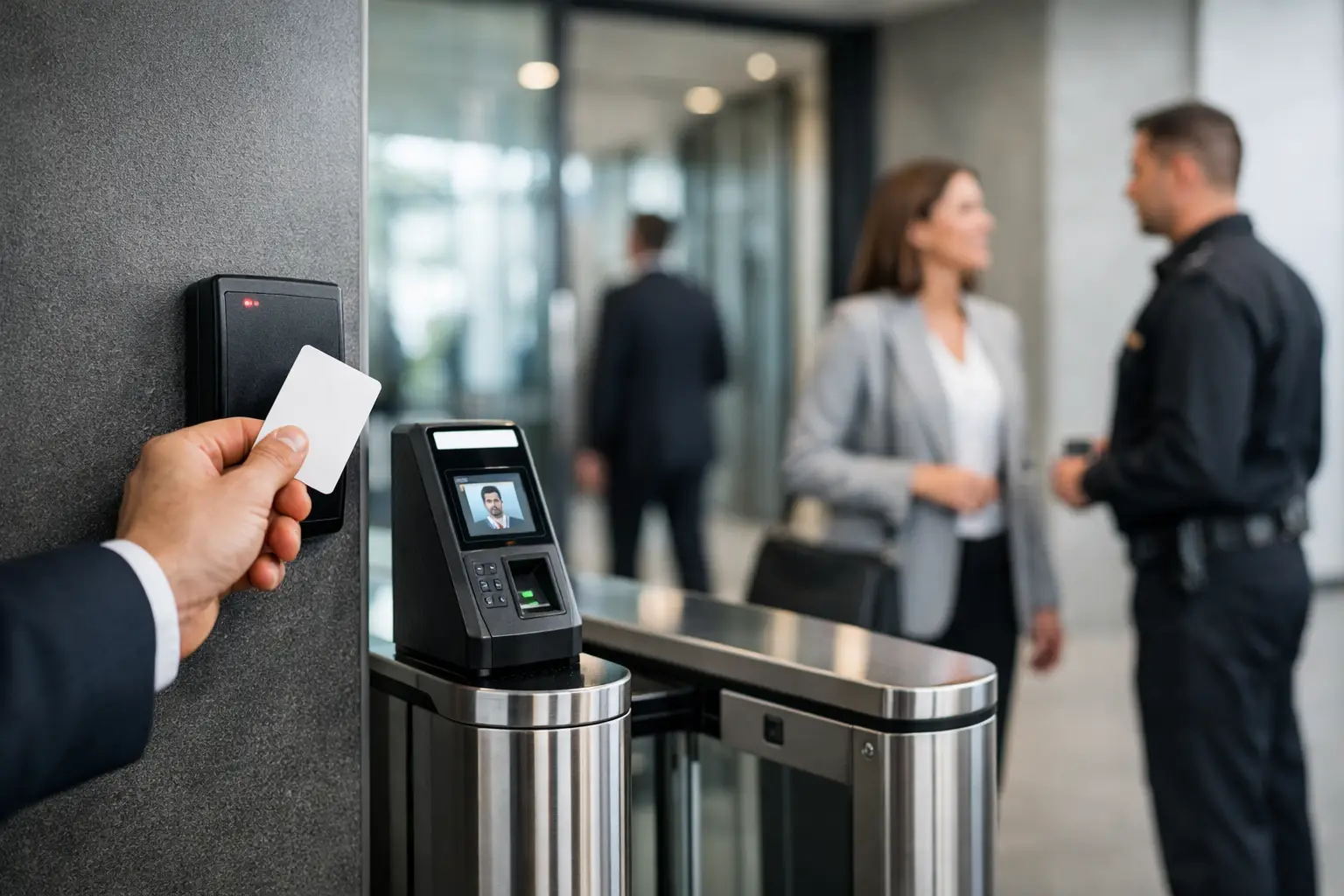
Card access, mobile credentials, PIN-based entry, and biometric authentication each have a place. Card or fob systems are widely used because they are familiar, scalable, and easy to manage across teams. Mobile credentials can reduce the need to issue physical items and are useful for businesses that want centralized control through software. Biometric readers add a stronger level of identity verification, but they should be deployed where that level of assurance is genuinely needed, such as server rooms, restricted offices, or high-value storage areas.
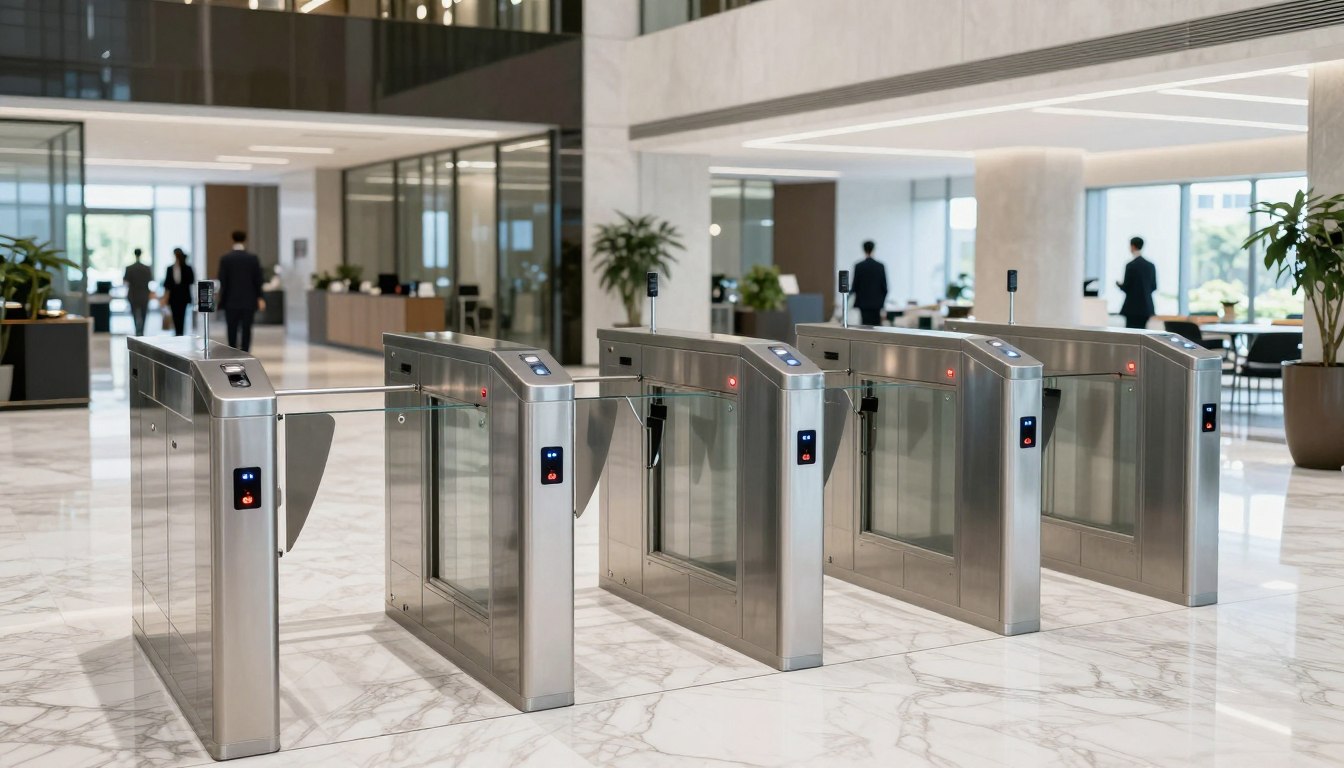
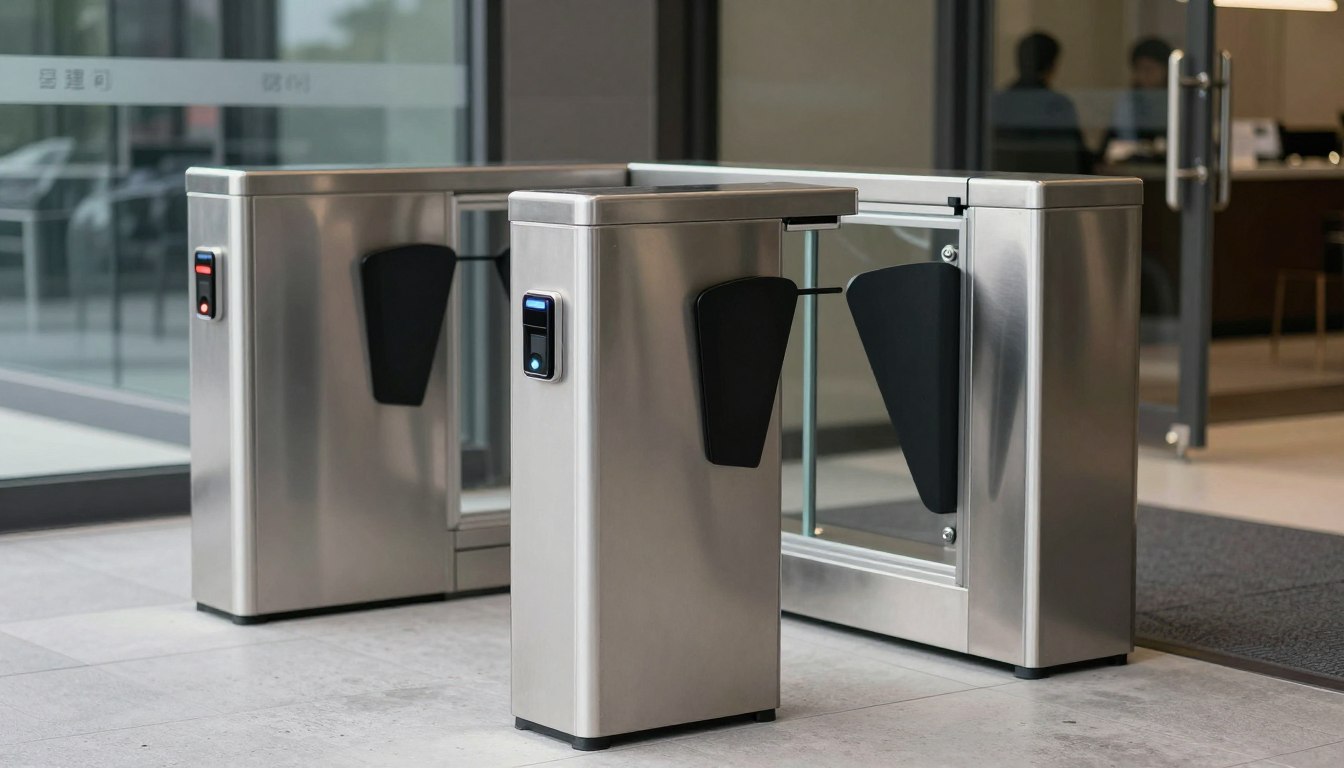
The right choice depends on budget, employee volume, and risk level. A smaller office may only need controlled front-door access and audit logs. A larger operation may need multiple access groups, time-based permissions, and integration with turnstiles or elevator controls. What matters is that permissions are easy to assign, easy to revoke, and aligned to job roles.
Use reception and visitor management as part of security
One of the most common entrance weaknesses is not forced entry. It is unverified entry. Visitors, contractors, vendors, and temporary staff often pass through the front door with minimal screening, especially during busy periods.
A secure office entrance should have a clear visitor process. That may include check-in at reception, temporary badges, host notifications, and limits on where visitors can go unescorted. In some offices, a simple reception-controlled release works well. In others, self-service visitor registration paired with access approval is more efficient.
The key is consistency. If employees sometimes challenge unknown visitors and sometimes do not, the system is not reliable. Good visitor management removes guesswork. It gives front-desk staff and employees a shared process that supports both professionalism and control.
CCTV supports verification, not just recording
Cameras are valuable at office entrances, but only if they are positioned and configured correctly. Many businesses install CCTV for general coverage and assume that is enough. In practice, entrance cameras should be designed for identification, not just broad visibility.
That means clear facial capture at entry and exit points, suitable lighting, and retention settings that support investigation if an incident occurs. It also means avoiding blind spots near doors, turnstiles, and reception areas. If a camera only shows the top of someone entering or is affected by glare from glass doors, it may not provide useful evidence.
CCTV becomes more effective when integrated with access control. When businesses can match a door event with video footage, they gain a much clearer picture of what happened, who entered, and whether access was authorized. That reduces response time and improves accountability.
Don’t ignore side doors, internal zones, and after-hours access
When businesses think about entrance security, they usually picture the main lobby. But risk often shifts to less monitored points such as side doors, parking lot entrances, loading areas, and stairwell access. These are common problem areas because they are used less frequently and reviewed less often.
The same applies inside the office. Not every person who enters the building should automatically have access to every area. Finance rooms, executive offices, IT closets, and server spaces often require another layer of control beyond the main entrance.
After-hours access deserves separate planning. Cleaning crews, shift workers, support teams, and approved contractors may need access when the office is mostly empty. That is exactly when visibility is lower and response times can be slower. Time-based permissions, door schedules, and event alerts help reduce risk without stopping legitimate work.
The network behind the entrance matters
Physical security systems rely on stable infrastructure. IP cameras, access control panels, intercoms, mobile credential platforms, and monitoring tools all depend on proper cabling and network performance. If the underlying infrastructure is weak, security becomes inconsistent.
This is where integration matters. A business may have quality devices at the door, but if the network is poorly designed, cameras may drop footage, access readers may lag, and remote administration may become unreliable. Structured cabling, segmented networks, power planning, and secure connectivity are not separate from entrance security. They are part of it.
For growing organizations, scalability should also be considered early. If another office, floor, or tenant area is added later, the system should be able to expand without a full redesign. This is often where working with an implementation partner that understands cabling, networking, and physical security together creates a practical advantage.
Policies and staff habits close the gap
Even well-designed systems fail when office habits work against them. Tailgating, door propping, shared credentials, and informal visitor handling are some of the most common weak points in otherwise secure offices.
That is why security needs a policy layer, not just a hardware layer. Employees should know how visitors are handled, when badges must be worn, what to do if a credential is lost, and how to report suspicious behavior. Reception teams need clear escalation steps. Facilities and IT teams need a defined process for onboarding and offboarding access rights.
Training does not need to be complicated. It needs to be specific enough to influence daily behavior. When people understand why a process exists and see that it is applied consistently, compliance improves.
Plan for maintenance, audits, and change
Entrance security is not a one-time installation. Businesses change, teams move, offices expand, and threat patterns evolve. A secure entrance today may become inadequate six months from now if permissions are outdated or equipment is not maintained.
Regular audits help identify inactive credentials, unnecessary access rights, failing door hardware, or camera coverage issues. Maintenance matters just as much. A door closer that no longer shuts properly or a reader that intermittently fails creates both a security problem and a daily operational frustration.
This is one reason many businesses benefit from a coordinated systems approach. Providers such as I-Weblogic Pte Ltd work across access control, CCTV, cabling, and network infrastructure, which helps reduce handoff issues between separate vendors and supports more reliable long-term operation.
The best entrance security is rarely the most complicated system. It is the one that fits the site, supports your workflow, and gives you confidence that the right people can get in at the right time for the right reasons. If your office entrance still depends on habits, keys, or partial visibility, that is usually the signal to redesign it before a gap turns into an incident.