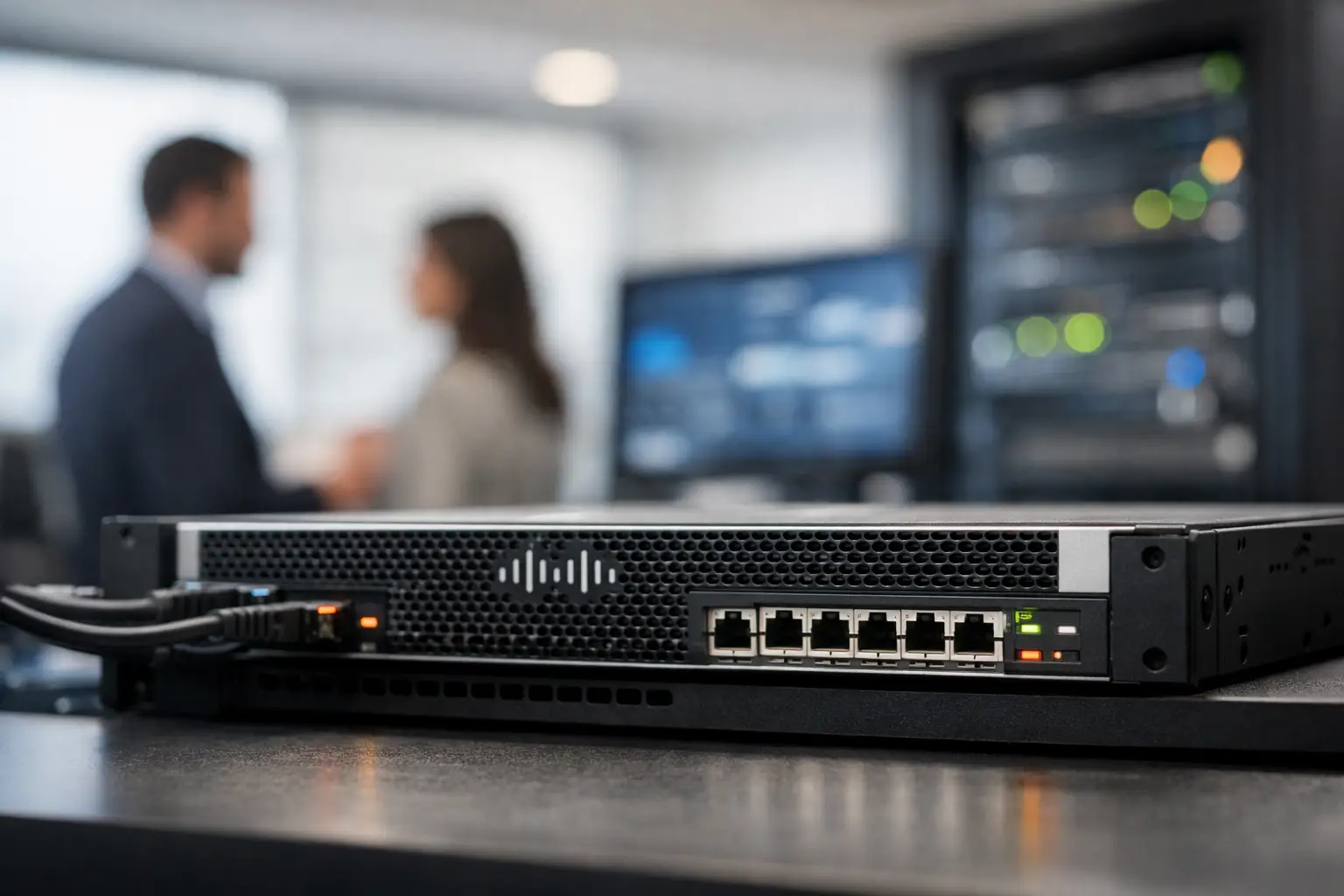
A firewall decision can affect far more than internet access. It determines how reliably staff can use cloud applications, how quickly an incident can be contained, and whether a growing network remains manageable across offices. This Cisco firewall review examines where Cisco Secure Firewall fits for business networks, the operational value it can provide, and the considerations that should be addressed before deployment.
Cisco is a credible choice for organizations that need security to work alongside enterprise switching, wireless, identity, and network segmentation. The strongest results, however, come from matching the firewall design to real traffic patterns, business applications, site requirements, and internal support capacity rather than selecting an appliance by headline throughput alone.
Cisco Firewall Review: What Businesses Are Buying
Cisco Secure Firewall is a family of next-generation firewall solutions designed to control traffic, inspect threats, enforce access policies, and provide visibility across on-premises and distributed environments. Depending on the deployment, organizations can use physical appliances, virtual firewalls, or cloud-based security controls.
For a business, the value is not simply blocking unauthorized connections at the network edge. A properly configured Cisco firewall can separate guest Wi-Fi from corporate systems, restrict access between departments or locations, help identify suspicious traffic, and apply consistent rules to remote users and branch offices.
This matters especially when an organization has a mixed environment. A corporate office may have wired workstations, wireless devices, IP phones, CCTV cameras, access control panels, cloud software, and connections to retail outlets or remote sites. Each device category has a different risk profile. The firewall becomes part of the framework that limits unnecessary exposure between them.
Cisco’s platform is generally best suited to organizations that value policy control, broad integration options, and a security architecture that can grow with the network. It can be a sensible fit for established SMEs with compliance concerns as well as larger enterprises that need centralized governance across multiple locations.
Security Capabilities That Matter in Practice
A modern firewall should inspect more than port numbers and IP addresses. Cisco Secure Firewall can provide application awareness, intrusion prevention, web and DNS security controls, malware protection options, VPN access, and traffic logging. The exact functions available depend on the selected model, software, and subscriptions.
Application visibility is particularly useful for IT teams trying to understand what is actually using network bandwidth. It allows policies to be based on the application in use, not only the device address. This supports more precise control over services such as file sharing, remote desktop tools, social media, streaming, and unauthorized cloud applications.
Intrusion prevention helps identify known attack patterns and suspicious network behavior. It is valuable, but it is not a substitute for patching servers, using strong identity controls, or separating critical systems from general user networks. Security is more effective when the firewall is deployed as one layer in a coordinated design.
Encrypted traffic presents another important consideration. Much business traffic now uses encryption, which protects confidentiality but can limit inspection if the firewall cannot evaluate the traffic. Decryption policies can improve detection, yet they also require careful planning around privacy, certificate management, performance, and applications that may not tolerate inspection. There is no universal setting that fits every organization.
For offices with CCTV, biometric access control, IP telephony, and business Wi-Fi, segmentation is often one of the most immediate benefits. Separating these systems into appropriate network zones can reduce the impact of a compromised device and prevent non-business equipment from reaching sensitive servers or finance systems.
Performance Is About Enabled Services, Not Just Speed
Firewall specifications can be misleading when viewed without context. A device may show high firewall throughput under basic testing, but real-world capacity changes when intrusion prevention, malware inspection, VPN connections, logging, decryption, and high-availability requirements are enabled.
For that reason, sizing should begin with the business environment. An IT manager should assess current internet bandwidth, expected growth, the number of users, remote-access demand, cloud application use, and the volume of east-west traffic between internal network segments. A busy office with hundreds of video calls, cloud backups, and wireless clients may require a different design than a retail outlet with a small staff and several connected cameras.
High availability also changes the conversation. Many organizations cannot accept a single firewall becoming a point of failure. A paired deployment can provide continuity if one appliance fails, but it introduces additional cost, rack space, power requirements, cabling, and configuration discipline. For a small branch, a well-supported standalone firewall with a practical replacement plan may be appropriate. For a headquarters or revenue-critical site, redundancy is often worth the investment.
The same principle applies to remote locations. A centralized security model can simplify policy management, but each site still needs adequate local connectivity and a clearly defined failover approach. An office relocation or new branch rollout is a good time to address these requirements before staff move in.
Management and Visibility: A Major Cisco Strength
Cisco’s management options are a significant advantage for organizations with multiple firewalls or complex policy needs. Centralized tools can help security teams manage rules, review events, monitor device health, and apply policies more consistently across sites.
That said, centralized management is most valuable when there is a clear operating process behind it. Someone must review alerts, remove outdated rules, validate changes, and investigate unusual activity. A firewall can generate extensive logs, but logs only improve security when they lead to informed action.
Businesses should also consider who will own day-to-day administration. An experienced internal IT team may want direct control over policies and reporting. An organization without dedicated security resources may be better served by a systems integrator that can design the firewall, document the configuration, support changes, and coordinate it with the wider network environment.
Cisco also works particularly well in environments that already use Cisco switches, wireless infrastructure, or identity services. Integration can improve visibility and policy coordination, although it should not be treated as a requirement. A Cisco firewall can operate effectively within a multi-vendor network when the design, VLAN structure, routing, and access policies are properly planned.
Where Cisco Firewalls Require Careful Evaluation
A balanced Cisco firewall review should recognize the trade-offs. Cisco’s breadth is an advantage, but it can also make product selection, licensing, and administration more involved than a basic firewall deployment. Organizations should confirm which subscriptions are needed for the protection and reporting capabilities they expect, as well as the ongoing renewal costs.
Policy design also deserves more attention than many buyers anticipate. Rules that are too broad can leave unnecessary access open. Rules that are too restrictive can interrupt business applications, voice services, remote access, or integrations with cloud platforms. A staged implementation with testing and rollback procedures reduces the risk of disruption.
There is also a learning curve. Cisco Secure Firewall offers considerable control, which benefits capable IT and security teams. For organizations seeking a simple, low-touch setup with minimal policy customization, another platform may be easier to administer. The right choice depends on the required security depth, not brand preference alone.
Support planning is equally important. Before purchase, confirm warranty coverage, hardware replacement expectations, software update responsibilities, escalation procedures, and whether the firewall provider will support the device after go-live. Security infrastructure should not be treated as a one-time installation.
A Practical Deployment Approach
The most dependable deployments start with discovery. Map the existing network, identify critical applications, document internet connections, and determine which users, devices, and systems need access to each other. This creates the basis for segmentation and firewall policies that support operations rather than restrict them unexpectedly.
Next, size the solution using real conditions. Include projected bandwidth, remote users, VPN traffic, security services, encrypted traffic inspection where appropriate, and the need for high availability. Leave room for business growth, but avoid oversizing so heavily that budget is diverted from other necessary improvements such as switching, wireless coverage, structured cabling, or backup connectivity.
Implementation should include a documented cutover plan. This typically covers rack and power readiness, WAN handoff details, VLAN configuration, routing, VPNs, rule testing, monitoring, backups, and a fallback process. For organizations upgrading during an office move or expansion, coordinating firewall deployment with cabling, wireless, access control, and CCTV installation can reduce rework and help avoid gaps between physical and network security.
After deployment, schedule policy reviews and software updates. Remove rules that are no longer required, verify that logs are being monitored, test remote access, and review network segments whenever new systems are introduced. I-Weblogic approaches firewall projects as part of the wider infrastructure foundation, because security performs best when connectivity, physical systems, and network design are planned together.
A Cisco firewall can be a strong long-term investment when it is selected for the environment it will protect and supported with disciplined management. The most useful next step is to define the business services that cannot fail, then build the firewall policy and network design around keeping those services secure and available.