A network can look fine on paper and still become a daily operational problem. Video calls freeze in meeting rooms, cloud applications lag at busy times, CCTV footage drops, and an office expansion exposes cable runs that were never designed for current demand. The copper vs fiber cabling decision is therefore not simply a technical choice. It affects how reliably your people, systems, security devices, and future locations can operate.
For most businesses, the right answer is not copper everywhere or fiber everywhere. It is a planned combination based on distance, bandwidth, device requirements, building layout, budget, and growth plans. Choosing correctly at the infrastructure stage reduces disruption later and gives your network room to support new services without repeated rewiring.
Copper vs Fiber Cabling: The Core Difference
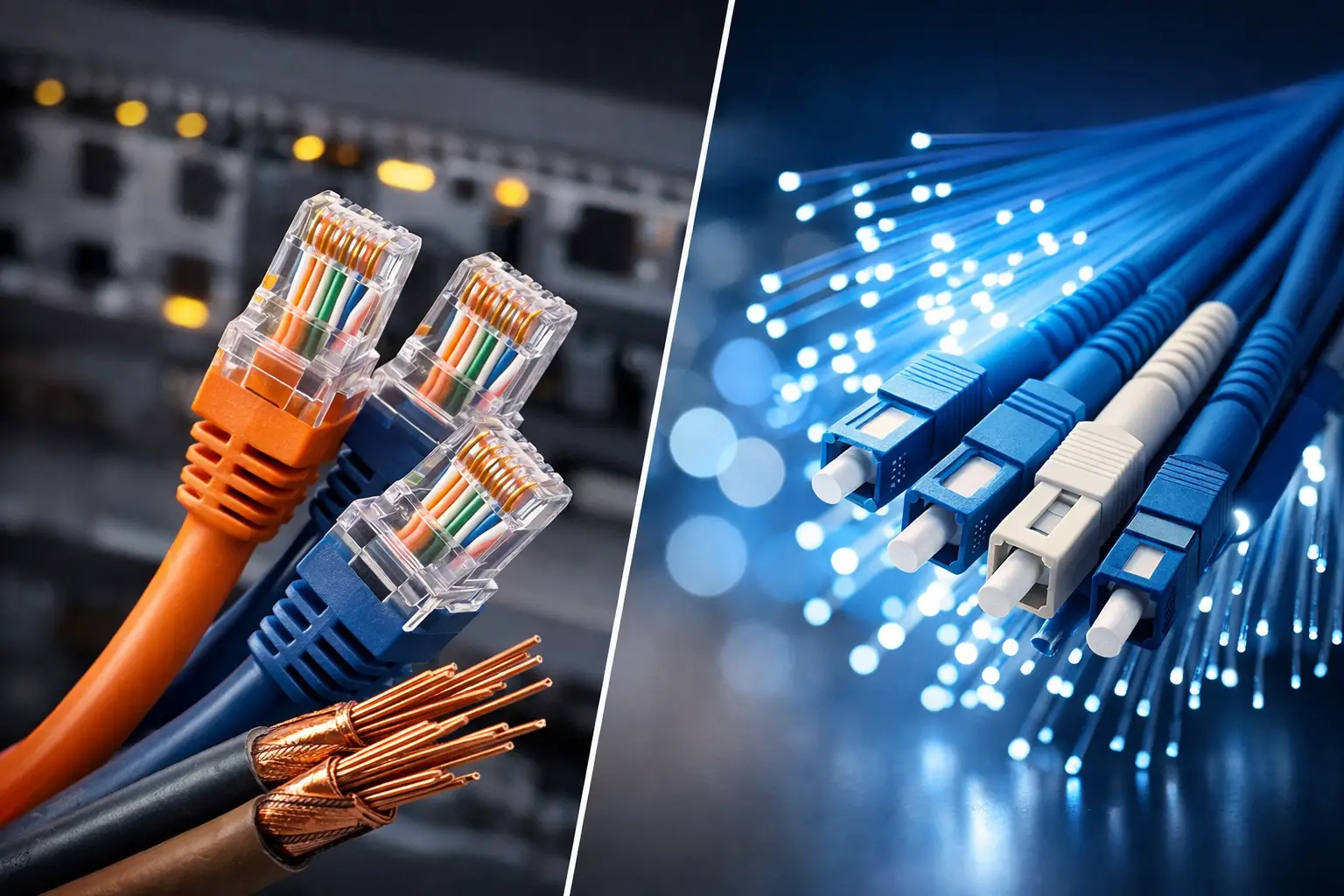
Copper cabling sends electrical signals through twisted pairs of metal conductors. In business environments, this usually means Category 6, Category 6A, or similar Ethernet cable. It remains the standard connection for workstations, wireless access points, IP phones, printers, access control readers, and many CCTV cameras.
Fiber optic cabling carries data as pulses of light through glass strands. It is designed for higher bandwidth over much longer distances and is commonly used as the backbone between floors, telecommunications rooms, buildings, data centers, and remote network cabinets.
The practical distinction is straightforward. Copper is highly effective for short, device-level connections and can provide both data and power. Fiber is better suited to high-capacity links, long cable runs, and environments where interference or future bandwidth demand is a concern.
Distance changes the decision
Standard copper Ethernet runs are typically limited to 328 feet, or 100 meters, including patch cords. This is sufficient for many office floor layouts, particularly when a network closet is centrally located. Beyond that distance, performance and standards compliance become an issue.
Fiber can carry data far beyond that limit. Multimode fiber is frequently used for high-speed links within a building or campus, while single-mode fiber is often selected for longer inter-building or wide-area connections. If a warehouse, guardhouse, production area, or separate building sits beyond practical copper distance, fiber is usually the more dependable design choice.
Bandwidth and future capacity
Both media can support fast business networks. Category 6 cabling can support 1 Gigabit Ethernet at standard channel lengths and may support higher speeds over shorter distances. Category 6A is commonly specified for 10 Gigabit Ethernet up to 100 meters, making it a sensible option for many modern office deployments.
Fiber offers significantly more headroom. A properly designed fiber backbone can support 10, 25, 40, 100 Gigabit connections and beyond, depending on the fiber type and network equipment. This matters when many users share cloud applications, large files move between servers, Wi-Fi capacity increases, or high-resolution surveillance cameras are added across a site.
The question is not whether every desk needs fiber. Most do not. The better question is whether the backbone feeding those desks, access points, and devices will have enough capacity three to seven years from now.
Where Copper Cabling Delivers the Most Value
Copper remains a practical and cost-effective choice for horizontal cabling, which is the cable run from a telecommunications room to an end device. It is familiar to installers, straightforward to terminate, and works with standard Ethernet ports found on most workplace equipment.
Its major advantage is Power over Ethernet, or PoE. A single copper cable can deliver network connectivity and electrical power to devices such as IP phones, wireless access points, cameras, door controllers, and biometric readers. This can reduce the need for separate power outlets and simplify installation in ceilings, entrance points, or outdoor enclosures where local power is inconvenient.
For a typical office, Category 6A is often a strong long-term option for new structured cabling. It supports 10 Gigabit Ethernet at full channel distance and is well suited to higher-power PoE devices. Wi-Fi access points, in particular, are placing greater demands on both cable bandwidth and available power as wireless standards advance.
Copper also has limitations that should be planned for rather than discovered after installation. It is more susceptible to electromagnetic interference than fiber, especially near heavy machinery, electrical infrastructure, or industrial equipment. It also creates a conductive path between buildings, which can introduce grounding and surge-related concerns. For these situations, fiber is generally safer and more appropriate.
When Fiber Cabling Is the Better Investment
Fiber is the preferred choice when a business needs to connect separate network areas at high speed over distance. It is commonly used as the vertical backbone in multi-floor offices, the primary link between a main equipment room and floor cabinets, or the connection between buildings on the same site.
Because fiber is non-conductive, it is not affected by electromagnetic interference and does not carry electrical current. That makes it valuable in manufacturing spaces, medical environments, areas with high electrical noise, and outdoor links where lightning and ground potential differences must be considered.
Fiber also supports stronger network segmentation and expansion planning. For example, a retail group may need a fiber backbone linking network cabinets that serve point-of-sale systems, guest Wi-Fi, corporate traffic, CCTV, and access control. A school may need fiber between administration, classrooms, labs, and auditoriums. These environments generate growing traffic that can quickly exceed the capacity of an older copper-only backbone.
The higher initial cost of fiber should be viewed in context. Fiber cable, termination hardware, optical modules, testing, and specialist installation can cost more than a comparable copper run. Yet the cost of replacing an undersized backbone after ceilings are closed, operations have grown, or a second building comes online can be far greater than making the right allowance during a fit-out or relocation.
Build a Hybrid Design Around Business Requirements
The strongest infrastructure designs commonly use both cable types. Fiber provides the high-capacity backbone, while copper connects end devices and supplies PoE where needed. This approach controls cost without limiting future expansion.
A practical design may place fiber between the main server room and each floor distribution cabinet. From each cabinet, Category 6A cabling can serve desks, meeting rooms, cameras, access control panels, wireless access points, and IP telephony. The result is a network that is easier to manage, easier to expand, and less likely to create performance bottlenecks at the building level.
There are several questions decision-makers should address before approving a cabling scope:
- How many users, devices, cameras, access points, and security systems must the network support now and over the next several years?
- What are the actual cable distances between network rooms, floors, buildings, and remote operational areas?
- Which devices require PoE, and will higher-power PoE standards be needed for future wireless or security equipment?
- Are there sources of electrical interference, outdoor routes, or separate building grounds that favor fiber?
- Will construction access be difficult after occupancy, making additional backbone cabling expensive or disruptive?
These questions turn a generic cabling quote into an infrastructure plan tied to business operations.
Installation Quality Matters as Much as Cable Type
The best cable specification will not compensate for poor installation practices. Bend radius, pathway capacity, cable separation, labeling, rack organization, grounding, fire-stopping, termination quality, and test documentation all influence network reliability and future maintenance.
A structured cabling system should be clearly labeled from the outlet to the patch panel and network switch. When a user reports a problem or a new device needs to be connected, accurate records prevent unnecessary downtime. Testing should verify that copper links meet their required category performance and that fiber links meet loss-budget requirements.
Coordination is equally important when cabling supports more than computer workstations. CCTV, access control, IP telephony, wireless networking, and firewall-connected network segments should be considered together. An access point installed after an office renovation may require more power than the original cable run can support. A new camera may need a network cabinet with available PoE capacity, cooling, and protected power. Planning these systems as one environment avoids costly rework.
For organizations managing a relocation, renovation, campus expansion, or security upgrade, an experienced systems integrator can align cabling, network design, and physical security requirements before work begins. I-Weblogic approaches these projects as connected operational systems, not isolated installations.
Make the Choice Based on the Next Phase of Operations
Copper is not outdated, and fiber is not automatically necessary for every connection. Copper remains the efficient choice for most endpoint devices, especially where Power over Ethernet is required. Fiber is the strategic choice for long distances, high-capacity backbone links, interference-prone environments, and infrastructure that must support substantial growth.
The most useful decision is the one that protects daily performance while leaving room for what comes next. Before selecting materials, map the spaces, devices, power needs, traffic patterns, and expansion plans that will shape your network. A cabling system is easiest to overlook when it works well – and most valuable when your business needs it to grow without interruption.