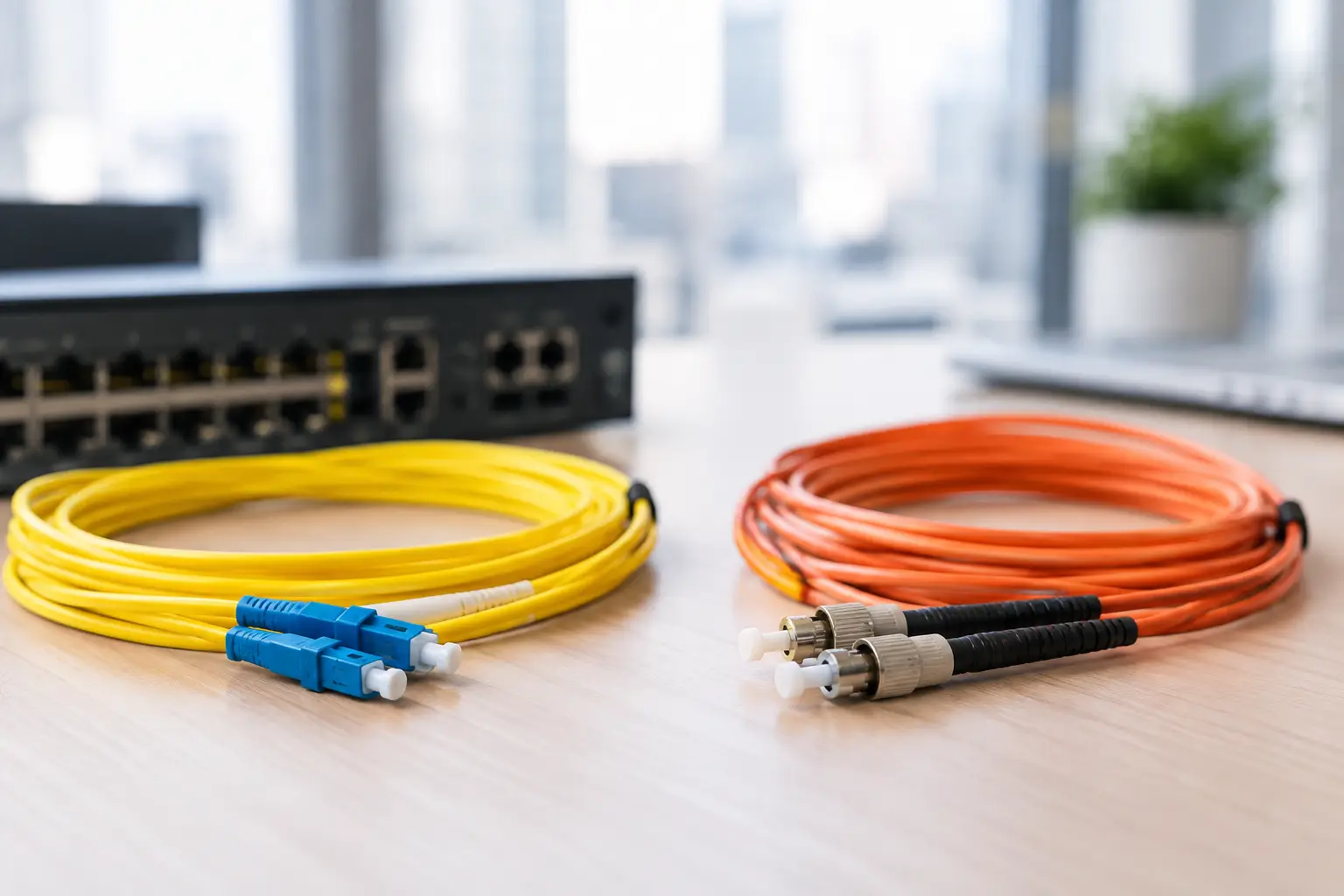
A fiber decision made during an office build-out can affect network capacity, expansion cost, and downtime for years. Single mode multimode fiber may sound like a technical choice best left to an installer, but the cable type influences how easily your business can add bandwidth, connect distant areas, and support new systems without reopening ceilings or conduits.
For most organizations, the right answer is not simply “single mode is better” or “multimode costs less.” It depends on the distances involved, the transceiver equipment your network needs, the building pathways available, and what your business expects from the site over the next five to 10 years. A practical fiber design starts with these operational requirements, then selects cable and electronics that work together.
What Single Mode and Multimode Fiber Do Differently
Both cable types transmit data as pulses of light through a glass core. The difference is the size of that core and how the light travels through it. This difference directly affects supported distance, bandwidth planning, and the cost of the optical modules installed at each end.
Single mode fiber has a very small core, typically 9 microns. It carries one primary light path, which reduces signal dispersion over long distances. That makes it the usual choice for connections between buildings, across campuses, from a main distribution frame to a remote facility, or for any backbone expected to extend well beyond a typical office floor.
Multimode fiber has a larger core, commonly 50 microns. It allows multiple light paths to travel at the same time. It is designed for shorter runs, particularly inside offices, data rooms, and buildings where distribution switches are relatively close together. Modern multimode grades can support high data rates, but the maximum distance decreases as speed rises.
The cable is only one part of the equation. The switches, routers, firewalls, wireless controllers, servers, and storage equipment require compatible optical transceivers. A low cable price does not necessarily produce the lowest project cost if the required optics, upgrade path, or future replacement work is overlooked.
Single Mode Multimode Fiber: The Business Decision
For a business owner or facilities leader, the decision usually comes down to three questions: How far must the link run? What capacity is needed now? How likely is the site to grow or change?
When single mode fiber is the stronger fit
Single mode fiber is generally the right foundation when a connection travels between buildings, across a warehouse, through a large campus, or to a remote communications room. It is also well suited to organizations planning higher-speed backbone links over time. A cable installed today can often remain in place through several generations of network equipment, while transceivers are upgraded as bandwidth requirements increase.
This makes single mode attractive for headquarters connected to annexes, schools with separate blocks, industrial sites, hospitals, and multi-building retail or hospitality environments. It can also be a sensible choice inside a large building where pathway access is difficult or disruptive. If pulling new cable later would require ceiling works, after-hours labor, or operational interruptions, installing a cable with greater long-term range can be commercially justified.
The trade-off is that single mode optics have historically cost more than comparable multimode optics, although the difference has narrowed for many common speeds. Costs still vary widely by network platform, port speed, and supplier. The proper comparison should include the full link: cable, termination, patch panels, testing, transceivers, labor, and expected upgrade requirements.
When multimode fiber is the practical choice
Multimode fiber remains an effective option for shorter backbone runs within a building. For example, an office may need to connect an equipment room to floor distribution cabinets, or a data room to nearby server racks. Where distances are comfortably within the limits for the planned speed, multimode can provide reliable high-bandwidth connectivity with cost-effective short-range optics.
It is especially relevant when an organization has an established multimode environment and is expanding in the same building. Matching the existing infrastructure can simplify spare management, documentation, and support, provided the installed fiber grade is verified first. Older multimode cable may not support the distance or speed required by newer equipment, so assumptions based on connector appearance alone are risky.
Multimode should not be selected only because the initial optics appear cheaper. If a project includes long runs, uncertain expansion plans, or expensive access to cable routes, a short-term saving can create an avoidable constraint. The right choice is the one that supports the site’s actual design life.
Distance and Speed Must Be Planned Together
Fiber specifications are often discussed in terms of speed, such as 10GbE, 25GbE, 40GbE, or 100GbE. These figures are only meaningful when paired with the required distance and the fiber grade. A multimode link that performs well at one speed over a short distance may not support a higher speed over the same route.
This matters when planning for wireless access points, IP telephony, CCTV storage, cloud applications, video conferencing, and growing file transfer demands. The access network may run at 1GbE today, while uplinks between switches need 10GbE or more to prevent congestion. As more devices and services rely on the network, backbone capacity becomes a business continuity issue rather than a purely technical specification.
Single mode provides more headroom for long-distance and high-capacity links. Multimode can perform very well for local high-speed connections, but its practical ceiling depends on the cable grade, length, and selected optics. A qualified installation team should measure real route lengths rather than relying on floor plans or estimated straight-line distances.
Installation Quality Is as Important as Fiber Type
Even the correct cable will underperform if it is poorly installed, incorrectly terminated, or inadequately tested. Fiber is more sensitive to handling practices than copper cabling. Bend radius, pulling tension, connector cleanliness, labeling, containment design, and termination quality all affect the finished link.
A properly managed project begins with a site survey and network design. The installer should identify communications room locations, pathway capacity, fire-stopping requirements, cable segregation, rack space, power availability, and the relationship between the fiber backbone and connected systems. This is particularly important where the same infrastructure supports network switching, wireless coverage, IP cameras, access control panels, and voice services.
Testing should be documented, not treated as a verbal assurance. Depending on the project scope, this can include optical loss testing and optical time-domain reflectometer testing to identify faults, excessive loss, or events along the cable route. Clear labeling at patch panels and distribution frames also saves significant troubleshooting time during a future move, add, or change.
Avoiding Common Fiber Planning Mistakes
One common mistake is mixing cable, connectors, and optics without verifying compatibility. Single mode and multimode systems use different optical characteristics, and connecting the wrong components can lead to failed links or unreliable performance. Connector color can provide a clue, but it is not a substitute for reviewing specifications and records.
Another issue is installing too few fiber strands. Labor and pathway access often make up a large share of the installation cost. Adding reasonable spare capacity during construction is usually far less disruptive than installing another cable later. Spare strands provide resilience if a fiber is damaged and room for future services or network paths.
Businesses should also avoid treating fiber as an isolated cabling package. The design should account for switch locations, uplink speeds, redundant paths where required, rack layout, uninterruptible power, cooling, and security. A disconnected approach can leave a technically sound fiber link attached to an undersized switch or a communications room that cannot support future equipment.
A Sensible Approach for Expanding Sites
For many businesses, a hybrid design is the most practical answer. Single mode fiber can serve inter-building links and long backbone routes, while multimode supports short, high-speed runs inside a data room or on a floor. There is no requirement to use one cable type everywhere if the network design benefits from both.
The key is to document the logic behind the decision. Record fiber type, strand count, routes, termination locations, test results, and the supported network equipment. This gives IT teams and future contractors a dependable baseline when adding a new floor, camera system, wireless upgrade, or secondary internet connection.
I-Weblogic approaches fiber infrastructure as part of the wider operating environment, not as a standalone cable pull. Coordinating structured cabling with switching, wireless networking, IP telephony, and physical security helps reduce conflicts during implementation and gives organizations a clearer path for growth.
Before approving a fiber scope, ask for a design that explains the required distances, current and future link speeds, spare capacity, testing method, and compatibility with the intended network hardware. That conversation turns fiber from a hidden construction detail into a dependable foundation for the work your organization needs to do next.